

What does a Southeast Asian summer look like? In Bangkok, Jakarta and Ho Chi Minh City, 35°C is normal, and humidity sits between 70% and 90% all year round. It is oppressive for people. For access control and attendance terminals, it is a test that never ends.
We have seen the same story many times: a terminal goes in, two or three months later the touchscreen starts drifting, the camera lens fogs up, the screen is unreadable on a west-facing wall at noon, and once the monsoon arrives, the unit at the factory gate starts crashing. The customer’s first reaction is “the product is broken” — more often, the problem was already decided on the day the hardware was chosen.
![MVI_5505[20260928-155938]](https://www.wedsodm.com/uploads/MVI_550520260928-155938.png)
Why heat and humidity are the “silent killer”
It does not destroy a device in one shot. It wears it down, day after day.
Heat accelerates the aging of electronic components. Capacitors, screen backlights and batteries lose life much faster when they run above 50°C for long stretches. Many indoor-rated devices are specified for 0–45°C; mounted at an unairconditioned construction-site gate, the housing can reach 60°C in summer, and failures start appearing within six months.
Humidity, combined with the day-night temperature swing, condenses moisture onto the PCB. Dampness seeps in during the day, cools at night and condenses into water traces; over months, solder joints and connectors oxidize and develop bad contacts. It is the most common cause of early field failure in this region — and the one most often ignored at selection time.
Direct sunlight washes out LCD screens. A typical indoor screen is only 250–300 cd/m²; under midday sun you can barely make out a face on it, let alone have an employee walk up and check in.
Add rain and dust, and an outdoor terminal ages three years in six months.
![MVI_5494[00_00_01][20260928-160100]](https://www.wedsodm.com/uploads/MVI_549400_00_0120260928-160100.png)
Five specs to check before you buy
First, look at the operating temperature — not the storage temperature.
Many spec sheets read “-20 to 60°C”, but that is the range a powered-off unit survives in a warehouse. What actually matters in the field is the operating temperature: the range in which it runs reliably while switched on. For outdoor or unairconditioned installs, look for at least 50°C on the high end, and leave a further 5°C margin for a west-facing wall.
Second, the operating humidity spec must be followed by “non-condensing”.
“10%–90% operating humidity” is the baseline. If “non-condensing” is missing, ask: how is night-time condensation handled? A serious manufacturer writes it into the spec sheet, because the question was designed for.
Third, pick the IP rating based on where the unit will be installed.
For outdoor posts and wall-mounted gates, IP65 is the floor — dust-tight and protected against water jets. For corridors, indoor access control and lobbies, IP54 is enough. In a glass booth or under a proper canopy you can relax it a little, but never mount an indoor-rated unit out in the open under a half-open roof.
Fourth, match screen brightness to the install location.
For indoor corridors and office lobbies, 300 cd/m² is enough. For outdoor, next to glass facades, or anywhere with west sun, pick a high-brightness screen of 500 cd/m² or more; otherwise at noon it is just a black panel.
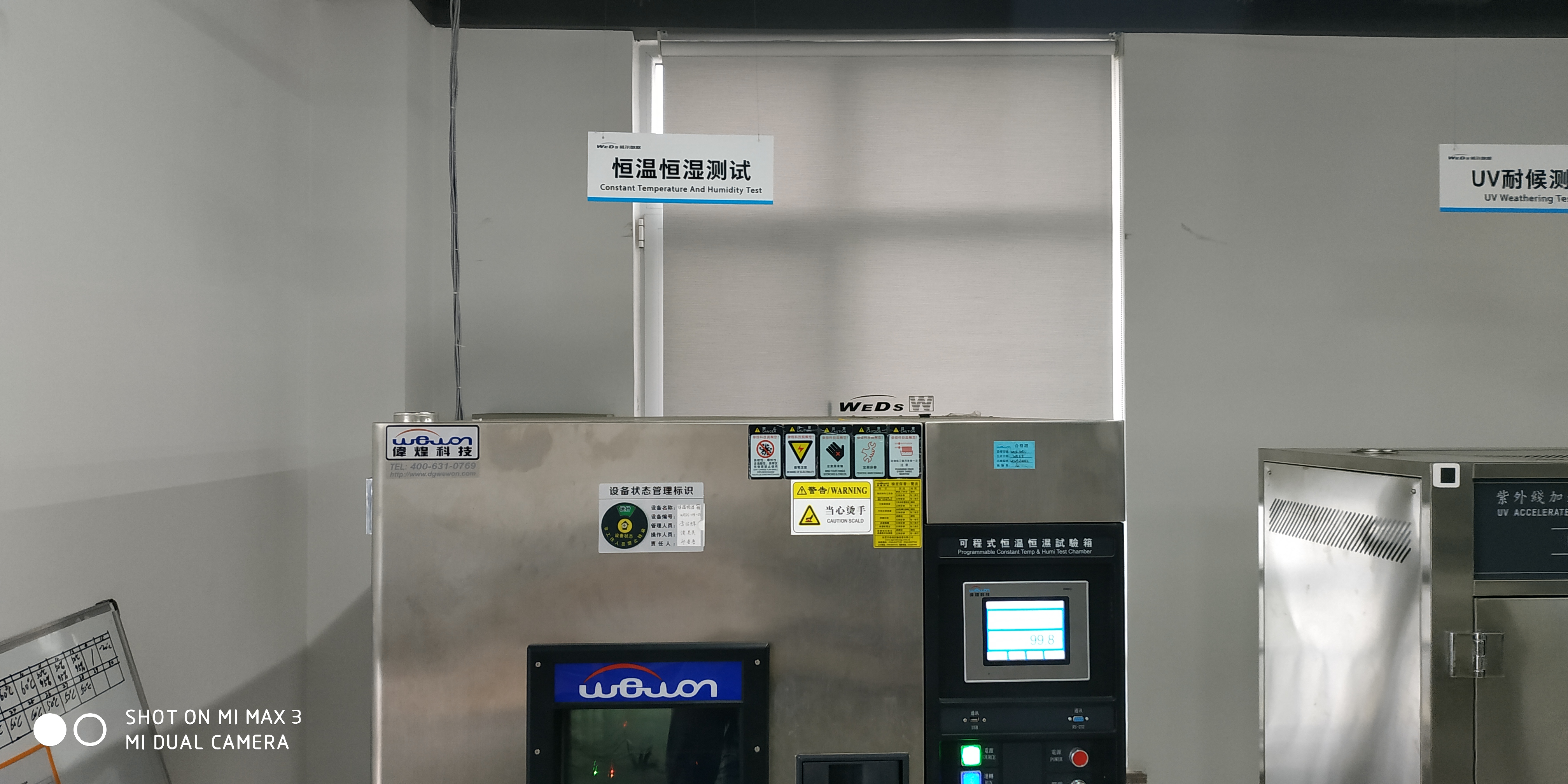
Fifth, ask whether units are aged before delivery.
This is the step most often skipped. A serious factory runs high/low-temperature aging, damp-heat testing, transportation vibration and electrostatic discharge on every unit before it ships. Ask for a test report, or simply ask “how many units from each batch do you bake, and for how long?” — a manufacturer who can answer has real confidence in its own product.
The shortest way to filter suppliers
If you do not want to study all these parameters, just ask any manufacturer three questions:
One — how long can this unit run continuously at 45°C and 90% humidity?
Two — do you have internal or third-party reliability test reports you can share?
Three — when a unit fails, do you replace it, repair by return, or offer remote support?
Ask these three, and most unreliable suppliers reveal themselves quickly.
About Us
Shandong Well Data Co., Ltd. (WEDS) was founded in 1997 and listed on the NEEQ in 2015 (stock code 833552). For nearly 30 years we have focused on the R&D and manufacturing of intelligent identification terminals. Today we hold 66 patents and 39 software copyrights, operate a 9,000 m² manufacturing park and employ more than 160 people. Our products are exported to over 90 countries and regions.
We run our own reliability lab, and every terminal leaves the line only after passing high/low-temperature aging, transportation vibration and electrostatic discharge tests. For the Southeast Asian market, our main models L4, M7 and N8 cover an operating temperature of -20°C to +60°C and operating humidity of 10%–90% non-condensing. The M7 carries an IP65 rating and the N8 an IP54 rating; screen brightness ranges from 300 cd/m² to 500 cd/m², matched to the installation location.
We provide full-process ODM/OEM services — from product design to customs clearance — with small-batch, customized and fast-delivery support, plus 7×24 dedicated technical support. The time difference with Southeast Asia is only about one hour, so working hours overlap almost completely.